Voici une chanson
de Christophe Maé – difficile de ne pas sourire. C’est édifiante comme musique. J’ai voyagé à Nouvelle Orléans en automne et
je l’ai bien aimée. La culture de jazz,
le beau temps, la cuisine...on peut « vivre la tranquille » comme le
dit Maé. C’est intéressant qu’il dit « même
si je ne suis pas d'ici, je connais par cœur les bords du Mississippi. » Je me demande s’il y a habité. En tout cas, c’est une belle chanson, et par
rapport à la première fois que je l’ai écoutée en automne dernier, je
comprends mieux maintenant. J’avais
aussi étudié les paroles un peu à l’époque.
Thursday, March 26, 2015

Wednesday, March 25, 2015
Top Chef
Bien joué,
Cyprien. Il offre ses pensées sur l’émission
Top Chef – les participants, les juges, les parties ridicules telles que la
compétition où on cuisine un beau menu afin de plaire un gamin. Cyprien remarque que les jeunes n’ont
généralement pas les palais les plus raffinés du monde – du coup on peut faire un
excellent plat, et quand même perdre la compétition. Cette vidéo m’a fait vraiment rire. Je ne regarde pas Top Chef, mais je cuisine
souvent. Cyprien se moque de la
présentation stylée des plats sur l’émission – on en fait de l’art, ce que je
fais de temps en temps – pourquoi pas ? Mais c’est drôle car on peut transformer un
plat normal, comme le fait Cyprien à la fin, en quelque chose d’extraordinaire (et
peut-être prétentieux) simplement en l’arrangeant nettement.
Monday, March 23, 2015
Elections municipales
Cet article
présente une analyse de situation politique en France suite aux élections municipales. L’auteur est carrément opposé au Front
national et réjouit que ses victoires ne fussent pas si convaincantes qu’avaient
indiqué les sondages. Madame Meskens affirme
qu’il faut réduire les sentiments extrêmes et « montrer un chemin »
pour retrouver « la confiance…en la politique ». Selon elle, le racisme et l’islamophobie sont
insupportables, mais il faut également éviter des actions qui vont trop loin en
accommodant des minorités. Elle parle du
danger d’une « crispation identitaire » juste après avoir mentionné
le voile à l’université et le porc dans les cantines, des questions qui en fait
ne doivent pas faire peur les français non-musulmans. Il me semble (et peut-être j’ai tort) qu’elle
dit « l’islamophobie n’est pas bon, mais il faut aussi garder une certaine
notion de la France pour ne pas la perdre ». A mon avis, il vaut mieux arrêter après « bon »
et laisser les gens vivre comme ils veulent, à moins qu’ils n’heurtent pas les
autres.
Wednesday, March 18, 2015
Agriculture urbaine
Article très
intéressant portant sur l’agriculture urbaine à Montréal. Selon M. Réal Ménard, quelques 42 % des citoyens
de la ville en engagent déjà. Il y a une
certaine bataille entre ceux qui participent dans ce mouvement à la fois
écologique, social, économique, et politique, et certains gouvernements locaux
au Québec. Ce débat m’intéresse car j’ai
envie de faire de l’agriculture urbaine aussi.
J’aimerais aider des communautés à devenir plus indépendants en ce qui
concerne l’alimentation, l’eau, tout ce dont une société a besoin pour vivre,
sans dépendre des produits envoyés de l’autre côté du monde pour des besoins
quotidiens. Le luxe, c’est bien de temps
en temps, mais il n’y a point raison pour laquelle nos communautés ne
pourraient pas cultiver leurs territoires et produire des aliments frais. En fait, beaucoup de gens en font à Montréal ;
maintenant la tâche est d’assurer que cette mode de vie soient protégée, et
également d’apprendre ce que l’on peut pour permettre à d’autres villes de
faire de même.
Dieux nordiques
Les
traditions nordiques sont toujours en vie ! Hilmar Örn Hilmarsson est prêtre d’Asatruarfelagid,
une réligion reconnue par l’état et qui renvoit à celle d’Islande avant qu’elle
s’est converti au christianisme il y a mille ans. Il la considère non pas comme la vérité, mais
comme un moyen de découvrir l’Antiquité.
Evidemment plein d’autres en Islande en ont envie, particulièrement
les jeunes. Même si neuf sur dix « font
leur confirmation dans l’église luthérienne officielle », il y a tant de
problèmes sociaux et économiques, voire écologiques, que beaucoup de jeunes
gens tournent vers le paganisme et les racines de leur peuple, pour voir s’ils
peuvent apprendre quelque chose de la société qui avait habité l’île depuis
longtemps.
Une chose
que j’ai appris, c’est l’expression « il a beau + [verbe en infinitif] »
comme « Hilmarsson a beau s’apprêter à construire un temple… » (« Hilmarsson may well be about to build
a temple… »)
Who's better at parking?
An interesting piece about a study that
shows women are better than men at parking cars. The article affirms that the stereotype of
women as poor drivers is common in almost all countries – I’d agree that is a
stereotype in places I’ve lived. In the
study, conducted for the largest parking company in the UK, 500 cars were
filmed while they parked, and a poll of 2500 drivers was conducted to determine
who parks better – women or men. Women
scored 13.4 out of 20 points, while the men scored 12.3. Women scored higher when it came to finding a
space, positioning the car in the space and backing up, while the men took less
time to maneuver into the space. They
are more impatient because they don’t want other drivers to steal their spot. Besides parking, another study concluded that
women are safer drivers on the road because they wear their seatbelts more
often, run fewer red lights, and talk less frequently on cellular devices while
driving.
I read this article rather easily, with
Google Translate support for single words or small phrases that I didn’t
understand.
Key vocab:
Sobre – about
Varones – males
Encuentrar – to find
Un lugar – place
Dar marcha atrás – reverse
Por supuesto – of course, surely,
definitely
Ya que – since, as, being that
Actividades culturales
Desde – from
Acaba – justUn derecho – a right
Tambien – also
Thursday, March 5, 2015
Au Bec Hellouin
https://www.youtube.com/watch?v=FXaD3NGRQQo
« On compense, je dirai, l’aspect très low-tech par l’intensité du design. »
« Rentrer dans une démarche de transition, c’est pas du tout une punition qu’on s’imposerait. C’est quelque chose au contraire…un processus libérateur, heureux, voilà, et qui rend la vie belle. »
Ici à la ferme du Bec Hellouin en Normandie, une famille prend soin de la terre tout en prenant soin d’elle-même. Grâce à un esprit innovante et les perspectives et les outils de la permaculture, la famille réussit à se nourrir sans dépendre sur l’importation de chaque repas de l’autre côté du monde. Moi, j’ai fait de la recherche là-dessus, indépendamment à mes études de français, et je voulais voir si la francophonie y participe. Eh bien oui, il paraît que les idées importantes sautent les barrières linguistiques. Il est clair après avoir vu cette vidéo que même les termes sont similaires ou pareils par rapport à la permaculture du monde anglophone. Pourtant, vu que la permaculture rassemble beaucoup de méthodologies agriculturales anciennes, y compris un peu de bon sens, il est clair que cette perspective n’appartient pas à un seul peuple. Ce que Bill Mollison et David Holmgren ont fait, c’était de condenser plein d’idées et méthodes tout en précisant une éthique reposant sur trois principes : prendre soin de la terre, prendre soin des hommes, et partager équitablement. Ce qui n’est pas, d’ailleurs, nouveau non plus, mais ces hommes et puis la communauté permaculturelle ont trouvé un moyen de parler la même langue. Au Bec Hellouin, il me semble que cette perspective a aidé la famille à créer de l’abondance.
"Luchador toda la vida"
This article was written by Johnny Araya Monge,
former presidential candidate for the Partido Liberación Naciona in Costa
Rica. He explains why he left and what
he hopes for the future of his country.
I had Google Translate open for the words I didn’t understand. Some of them are below:
Luchador – wrestler, fighter
Sobrada – ample
Pelear – quarrel, fight
Señal – signal
Lograr – achieve
Encima – above, over
A tiempo – on time
Hijos – offspring, kids
Nietos – grandchildren
Hace 191 años – 191 years ago
Overall, not too difficult, although I have to be
disciplined to read for the message, not just for comprehension of individual
words.
Wednesday, March 4, 2015
Cyprien dessine sa vie
https://www.youtube.com/watch?v=E_ifa0lJwOQ
Dans cette vidéo,
Cyprien nous raconte son histoire : sa jeunesse, son expérience à l’école, et
comment il est devenu fameux sur YouTube.
Il est jeune, mais avec de la persistance il a réussi à faire rire les
gens avec l’aide de la technologie. Il
était certain que quelqu’un le ferait, vu que des milliards de personnes ont l’accès
à l’Internet, mais dans cette époque où l’Internet est encore jeune, Cyprien
est l’un des innovateurs.
Noticias
https://www.youtube.com/watch?v=TG_hW64l5iU
I'm finding that it's easier to listen to people talk about international news than everyday subjects. I can pick up names and key points if I'm familiar with the topic, then listen for details rather than try to understand the main message.
I'm finding that it's easier to listen to people talk about international news than everyday subjects. I can pick up names and key points if I'm familiar with the topic, then listen for details rather than try to understand the main message.
Sunday, February 22, 2015
"Fuiste tú"
Today I listened to/studied the song "Fuiste tú" by Ricardo Arjona feat. Gaby Moreno. Enjoyed the music and the video (beautiful scenery), and figured I'd find out what they were saying. On first listen I picked up pronouns and a few words, but didn't quite catch the overall meaning. I thought it was a love song, since the music seemed uplifting to me. Upon analysis of the lyrics, though, I realized it's a breakup song. Oh well.
My process was to look up the lyrics in Spanish and read along as the music played a couple times, then Google Translate them and analyze it line-by-line (since Google only provides an approximation and sometimes gets it wrong). I then wrote out by hand about half the song, so that I could get used to writing Spanish in addition to typing. As I was writing, I'd stop every line or so and listen to that part of the video. The more I listened, the more I picked up and actually more or less memorized. I think I'll add the song to my collection of Spanish music, burn a CD, and listen as I drive around.
I also found another great resource, Spanishdict.com, which has not only a dictionary but a conjugator as well. I learned some new verbs today and started to recognize tenses of those verbs. Also read Spanishdict's explanation of the difference between ser and estar - ser is used for permanent characteristics, and estar is used for temporary states. Although the time is expressed with ser, even though it's constantly changing.
Afterward I listened to "Cuando Me Enamoro" and "No Me Digas Que No" by Enrique Iglesias, songs which I discovered recently and felt like hearing again. Also listened to "Rival" by Romeo Santos feat. Mario Domm. Understood a little, and picked up on the line "No quiero ser mas tu rival."
Wednesday, February 18, 2015
Vidéo de Cyprien
Ça fait
longtemps que je n’ai pas vu de vidéos de Cyprien, mais je l’ai découvert de
nouveau. Ces vidéos me font rire et c’est
utile pour m’habituer au français de tous les jours. Je me suis rendu compte que voir des
reportages – de France 24, par exemple – ne me pose presque plus de problèmes
au niveau de la compréhension générale, car il s’agit d’écouter du langage
standard et, même si les personnes parlent assez vite, elles prononcent les
mots quand même assez clairement. Par
contre, je n’arrive pas à comprendre tous les conversations entre
interlocuteurs natifs – ils utilisent des mots que l’on ne trouve pas à la
télé, et ils parlent souvent plus vite vu qu’ils ne parlent pas à une audience
énorme, mais bien à des personnes qui sont habitués à se parler d’une manière
plus informelle.
Donc pour cette
deuxième partie du projet (qui n’est que le début d’un projet plus long – j’espère
faire vivre ce blog durant des années) j’ai en tête de découvrir le français de
tous les jours, des jeunes, en passant par des chaînes YouTube comme celles de
Cyprien et de Norman, par la musique, etc.
Dans cette
vidéo, je comprends bien ce que Cyprien dit.
Il raconte ce qu’il a fait en 2014, et en somme il dit « bref avec
cette chaîne, on fait vraiment tout le temps n’importe quoi et ça, ça me fait
extrêmement plaisir. » J’ai hâte de
voir ses vidéos que j’ai manquées ces derniers mois.
Musica latina
The following musicians have been playing on my computer for several weeks now:
Romeo Santos
Prince Royce
Enrique Iglesias
Tito Puente
A-Z Lyrics has compilations of lyrics for many of their songs:
http://www.azlyrics.com/r/romeosantos.html
http://www.azlyrics.com/p/princeroyce.html
http://www.azlyrics.com/i/iglesias.html
Great thing about music - when you listen over and over again, you start to understand the message without having to translate, and by repeating the lyrics, you practice pronunciation. I've listened to 'Bailando' by Iglesias quite a few dozen times now, and while I don't understand everything (and don't have time to study every line in every song), I'm on my way. Reading the lyrics as I listen is a good way to pick up on things I would miss if I were just listening (since it helps me to visualize how words are spelled as I hear them).
Although I haven't had much time to spend reading articles and watching videos lately, I listen to a lot of music while at work...just have it playing softly in the background. I'm getting used to the sounds of Spanish - the soft d's, the rolled r's, the g's that sound like h's, the y's that sound like j's, the s's that sound like th's (in European Spanish), the unaccented final e's that sound like French é's, etc.
HISTORIA DE COLOMBIA EN 4 MINUTOS
https://www.youtube.com/watch?v=dZYMW7UdMmE
I am ignorant of most of the history of the Spanish speaking world, but I do know that just because Spanish is spoken in both Mexico and Argentina, for example, doesn't mean that those two countries share a common history. I want to understand how different regions of South/Latin America, Spain, and the southwestern U.S. have experienced history differently, and one way to do this is by listening to the people tell their own story, as they understand it.
This 4-minute video describes the history of Colombia in 4 minutes. The narrator speaks decently slowly, and I was able to understand a good amount of it. Linguistically, I noticed how he pronounced the 'D' sound softly, as in 'periodo.' Sometimes sounds like he could be saying 'th.' I picked up on adverbs like 'lentamente' and 'quando.' The r's are rolled beautifully. Noticed descriptive adjectives like 'en este etapa.' Often had difficulty when, for example, I'd hear an unfamiliar verb and then focus on it for half a second too long, enough to miss the next few words. I'm realizing that it helps me to know how words are spelled - if I can imagine it while I'm hearing it, I have an easier time understanding. Often the rolled r, beautiful though it is, will throw me for a loop because it'll take so long that I'm imagining several letters, when really there's only one r and the narrator's taking his sweet time. Another phonetic difficulty is combined vowels - not necessarily diphthongs, but clusters of syllables that are filled with vowel sounds. Since I'm not used to the ways vowels are used in Spanish (particularly their grammatical functions at the ends of words), it's hard for me to decipher how the words are spelled, thus I miss the meaning.
Content-wise, I didn't learn a whole lot since this was a broad overview, and doesn't go into much more detail than an American high school history book. I did think the narrator's tone was a little cheery given the violent history of the country, but oh well. Not too many places on earth are free from violence.
I am ignorant of most of the history of the Spanish speaking world, but I do know that just because Spanish is spoken in both Mexico and Argentina, for example, doesn't mean that those two countries share a common history. I want to understand how different regions of South/Latin America, Spain, and the southwestern U.S. have experienced history differently, and one way to do this is by listening to the people tell their own story, as they understand it.
This 4-minute video describes the history of Colombia in 4 minutes. The narrator speaks decently slowly, and I was able to understand a good amount of it. Linguistically, I noticed how he pronounced the 'D' sound softly, as in 'periodo.' Sometimes sounds like he could be saying 'th.' I picked up on adverbs like 'lentamente' and 'quando.' The r's are rolled beautifully. Noticed descriptive adjectives like 'en este etapa.' Often had difficulty when, for example, I'd hear an unfamiliar verb and then focus on it for half a second too long, enough to miss the next few words. I'm realizing that it helps me to know how words are spelled - if I can imagine it while I'm hearing it, I have an easier time understanding. Often the rolled r, beautiful though it is, will throw me for a loop because it'll take so long that I'm imagining several letters, when really there's only one r and the narrator's taking his sweet time. Another phonetic difficulty is combined vowels - not necessarily diphthongs, but clusters of syllables that are filled with vowel sounds. Since I'm not used to the ways vowels are used in Spanish (particularly their grammatical functions at the ends of words), it's hard for me to decipher how the words are spelled, thus I miss the meaning.
Content-wise, I didn't learn a whole lot since this was a broad overview, and doesn't go into much more detail than an American high school history book. I did think the narrator's tone was a little cheery given the violent history of the country, but oh well. Not too many places on earth are free from violence.
Thursday, February 5, 2015
Video: Message to young people
In this video, Yali Núñez is welcomed on a show and talks
about her hopes for millions of young people in Cuba, Mexico, and elsewhere to
succeed, and also thanks her mother and father for raising her. I’m not entirely sure why she is so excited
and happy, but I think it has something to do with her being a Cuban citizen
and escaping to America. I picked up on
several small points, like the use of pronouns (ti, ustedes), possessive
adjectives (mi papa), and vocabulary (pregunta – question). They’re speaking fast enough that I can’t
comprehend most of their words, but sometimes the message is still more or less
clear through the use of body language, tone, and emphasis on certain words
that I do understand.
La terre – chez nous
C’est incroyable
comment la terre peut être utilisé comme matériel de construction extrêmement
durable. Cette vidéo montre un projet en
Nouvelle Zélande où une équipe bâtit une maison avec de la terre, de l’eau, des
fibres de lin, et quelques équipements pour en faire quasiment des briques de
béton. Puis on voit des structures
anciennes en Chine qui ont été construites par probablement des centaines d’hommes
pendant des mois, mais qui sont toujours très stables. C’est intéressant qu’aujourd’hui nous
privilégions des matériaux tels que l’aluminium et le béton, et selon notre
perspective, notre civilisation est très avancée ; pourtant, on voit avec
chaque catastrophe naturel que nos maisons et bâtiments ne sont pas finalement très
bien construits par rapport à la force de la nature. En même temps, les structures de plusieurs
civilisations très anciennes (celles de la Chine dans la vidéo ont quelques
deux milles ans) ont sans doute survécu des milliers de tempêtes.
Maisons vertes
Ce petit
reportage montre deux maisons dites vertes à Saint-Donat et à Montréal. L’architecte Maryse LEDUC en construit depuis
25 ans et le décrit comme « une mode de vie » d’être « en
harmonie avec l’environnement ».
Elle choisit des matériaux venant du Québec, et elle conçoit des systèmes de
conservation de l’énergie tels qu’un échangeur et recycleur d’air.
A mon avis, c’est
super ce que Mme LEDUC fait. Il est
clair que nous avons besoin de changer notre mentalité par rapport à nos modes
de vie, c’est-à-dire trouver un moyen de vivre sans détruire notre
environnement. Plus efficacement gérer
la consommation de l’énergie et de l’eau, c’est un travail important
particulièrement pour ma génération.
Comme je n’ai pas encore acheté une maison, je garde en tête ces idées
pour l’avenir quand.
Par rapport á l’élément
langagière de la vidéo, j’étais à l’aise écoutant du français québécois. Ce n’est pas toujours le cas, car l’accent et
l’argot de la région peuvent parfois me confondre.
Mais vu que cette vidéo avait quand même quelques termes techniques, je
suis content que j’ai compris presque tout.
Monday, February 2, 2015
"Les meilleurs moments"
Moins de 4
minutes pour résumer 64 minutes d’actualités; pas mal. Plusieurs drames se déroulent en ce moment, y
compris en Centrafrique, au Royaume Uni, en Syrie, en Ukraine, en France, et ailleurs. En Centrafrique, la milice qui s’appelle
Seleka a été expulsée par les forces françaises et les alliés africains, ce qui
amène de la paix et de la sécurité finalement pour un pays qui a connu trop de
violence ces derniers mois. Un projet de
loi controversé lié aux droits de la famille a été rapporté à l’an prochain,
face à une manifestation « hostile » par l’opposition de droit. Au Royaume Uni, le gouvernement anglais ne
permet pas à Dieudonné d’entrer dans le pays pour soutenir un footballer qui a
fait un « quenelle », un geste controversé. Dieudonné est récemment sorti du garde à vue
après avoir été arrêté pour son Tweet « Je me sens Charlie Coulibaly »
après les attentats en France en janvier.
Un titre qui m’a
surpris, c’était les nouvelles de l’attaque sur les bases de données de la
société Orange. Il paraît que des
informations personnelles de 800.000 personnes auraient été volées. Comme je suis ancien client d’Orange, cela ne
me rassure pas. Les noms, addresses, et
numéros de téléphone ont été « robbés » (si j’ai bien compris le mot
utilisé – comme « to rob » en anglais, je crois). L'autorité interviewé dit qu’ « il faut
garder une certaine vigilance » puisqu’il se peut qu’un individu s’identifie
avec un nom qui n’est pas le sien, afin d’effectuer une transaction bancaire
par exemple et voler de l’argent. C’est
troublant, mais il est vrai que l’on fait face à cette possibilité de vol d’identité
dans l’ère de l’Internet.
Sunday, February 1, 2015
Attentat en Libye
« L’Etat
Islamique » est-il responsable de l’attentat à l’hôtel libyen du 27 janvier ? Dans cette petite interview, on apprend qu’«
au moins 13 personnes dont les 5 assaillants sont morts » dans l’attaque et que
l’EI a revendiqué la responsabilité.
Pourtant, les autorités libyennes doutent que ce soit le cas, car, comme
l’explique Armelle CHARRIER, l’hôtel est une « cible privilégiée ». Normalement, il est bien gardé et à l’époque,
avant la guerre, accueillait des délégations de l’UE et du Qatar. De plus, comme il y a deux gouvernements
actuellement en Libye, il serait possible, selon les autorités de Tripoli, que
ceux de Tobrouk ont attaqué l’hôtel afin de démontrer une lapse de sécurité qui
nécessiterait plus de protection (et donc du pouvoir) du gouvernement de
Tobrouk. Pourtant, Mme CHARRIER dit que
ce n’est pas impossible que l’EI serait responsable, vu que l’organisation a
déjà pris la ville de Derna sur la côte Méditerranée – ce qu’elle appelle comme
une réelle implantation dans la région.
Opinion article
This article by Sara Sefchovich is a
scathing criticism of the political system, parties, and leaders of Mexico. The author laments that “los que gobiernan”
only care about their own personal well-being and re-election, while the people
are suffering. Millions of dollars are
spent on campaigns while, for example, a hospital’s hemodialysis system was
shut down for lack of funding. What are
the people who depend on that service supposed to do? The news stations are complicit in this disregard
for public welfare, the author asserts.
This fundamental divide between those in charge and the rest of the
country, she cries, explains the violence in Mexico.
In reading this article, which I
selected out of the opinion section of the website, I tried to keep a steady
and fairly fast pace. There were plenty
of unfamiliar words, but by looking out for clues from sentence structure,
familiar conjunctions and small words, and cognates with French and English, I
was able to pick up the main idea as well as a number of details. I am beginning to recognize verb tenses and associate
them with the appropriate number/person, even if, as is often the case in
Spanish, the subject is omitted.
News clip
What I understood: A truck exploded near
a maternal hospital in Mexico City, killing 50 children and affecting 30-40% of
(something). Officials are unsure what
caused the explosion.
I watched this video once at normal
speed, once at half speed, and again at normal speed. I picked up on the use of que as in the French que, along with the different
pronunciation (kay versus kuh).
Getting to know the present tense
Time for
some grammar, with some bachata in the background (https://www.youtube.com/watch?v=iFyp1P_NsMI).
1) Verb
familiarization:
Bailar
– dance
Nadar – swim
Conducir – drive
Necesitar – need
Deletrear – spell
Poder – can/be able
Olvidar – forget
Limpiar – clean
Gastar – spend
Despertar – wake up
2) Present tense conjugation:
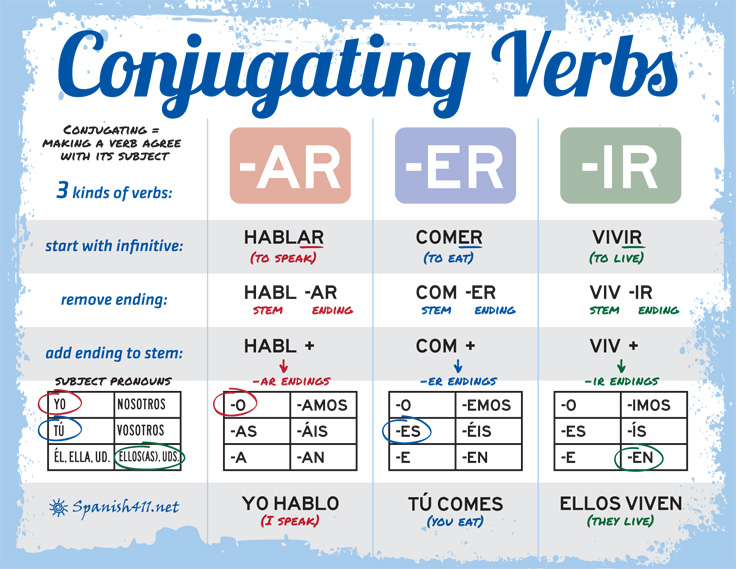
This site has a good outline of verb
conjugation. The concept of different
endings depending on person and number is the same as in French, but it’s
interesting that Spanish has a singular and a plural formal subject
pronoun. Usted/ustedes versus just vous. Since Usted
is a way to express the second person, I thought it would conjugate like tú, but instead it conjugates like
él/ella. Important to remember.
Wednesday, January 21, 2015
State of the Union 2014 analysis
http://www.bowdoin.edu/~eyepes/newgr/ats/25.htm
This morning I studied two chapters of Spanish grammar: uses of ser and estar, and el participio. Essentially the same usage as in French.
https://www.youtube.com/watch?v=g7beuWewFAc
I also watched a video from 29 Jan 2014 entitled “La visión de Rusia sobre el discurso del estado de la Unión de Obama.” It was produced by Euronews, a station operating out of Lyon. This video was in Russian, dubbed over in Spanish, with name/title captions in English. It was a challenge to pay attention to the Spanish while filtering out the Russian. I understood that they were talking about the recent State of the Union address by President Barack Obama. The interviewer asked Mr. Kortunov, a political analyst, about several topics including Ukraine, Iran’s nuclear program, and the war in Syria.
I originally clicked on this video because I thought it would analyze Mr. Obama’s speech from 20 Jan 2015, but it’s interesting to look back a year at an analysis of important issues as they stood in early 2014. A lot has happened since then – Ukraine is embroiled in violence, a sizeable jihadi force is challenging both the Iraqi and Syrian governments for control of territory, the West is still negotiating with Iran over its nuclear program, to name a few. I look forward to revisiting this video when I have a better understanding of Spanish.
Linguistically, I am beginning to be able to identify the parts of speech when I hear a sentence, and there are many words that are similar to French and English words. I recognize common endings of adjectives and adverbs, but I'll often lose track of the message when I spend even half a second extra trying to decipher an unfamiliar word. One way I'll improve is to expand my vocabulary, both by listening to authentic material like this video, and by making/studying lists of words.
Tuesday, January 20, 2015
New project
From January to April 2015, I will be studying French and Spanish. I intend to use this blog as a record of my language learning activities; after reading an article or watching a video, I will post the link to the blog and write a summary/reflection. Target frequency is 2-3 posts per week, although I may read/listen/watch more than this without posting about every article/video. I also intend to study grammar through websites devoted to this end, in addition to paying attention to usage in articles/videos.
Target competencies for improvement are listening and reading. Writing blog posts in the foreign language will allow me to improve in that area as well. Speaking and interacting is harder to do when learning on your own, but I am comfortable with pronouncing words, reading aloud, repeating the dialogue on videos, etc. Of course, nothing beats conversing with a native speaker, so I'll keep an eye out for opportunities when I'm traveling, in the mall, etc.
Goals for French: be able to better understand familiar French as well as the French that is used in the rest of the Francophone world. I am most comfortable with the language used on news broadcasts, in the classroom, in the restaurant, etc., because I've been exposed to those situations the most. I have trouble with street French - the lower registers of the language that often mix with Arabic, for example, and that are used most by young people. I would like to expand my vocabulary on the upper end of usage, as well - the flowery, sometimes obscure words you'd find in a poem or a dissertation.
Goals for Spanish: be able to understand most news broadcasts and articles; establish a strong familiarity with the grammar; be able to pronounce every sound in the language; and begin to understand the cultures and worldviews of Spanish-speaking regions.
Organization of the blog: At the top are the pages: Home, francais, espanol. Home is where all blog posts live. The francais page provides quick access to resources for learning French, including instructional sites and French-language news sites, etc. Ditto for espanol. The labels, located on the right-hand side of the blog, allows you to filter the posts by language and by competency. For example, clicking on "francais" takes you to all posts that relate to my study of French. The "listening" label takes you to all posts where I have watched a video, listened to a song, etc., regardless of the language.
Target competencies for improvement are listening and reading. Writing blog posts in the foreign language will allow me to improve in that area as well. Speaking and interacting is harder to do when learning on your own, but I am comfortable with pronouncing words, reading aloud, repeating the dialogue on videos, etc. Of course, nothing beats conversing with a native speaker, so I'll keep an eye out for opportunities when I'm traveling, in the mall, etc.
Goals for French: be able to better understand familiar French as well as the French that is used in the rest of the Francophone world. I am most comfortable with the language used on news broadcasts, in the classroom, in the restaurant, etc., because I've been exposed to those situations the most. I have trouble with street French - the lower registers of the language that often mix with Arabic, for example, and that are used most by young people. I would like to expand my vocabulary on the upper end of usage, as well - the flowery, sometimes obscure words you'd find in a poem or a dissertation.
Goals for Spanish: be able to understand most news broadcasts and articles; establish a strong familiarity with the grammar; be able to pronounce every sound in the language; and begin to understand the cultures and worldviews of Spanish-speaking regions.
Organization of the blog: At the top are the pages: Home, francais, espanol. Home is where all blog posts live. The francais page provides quick access to resources for learning French, including instructional sites and French-language news sites, etc. Ditto for espanol. The labels, located on the right-hand side of the blog, allows you to filter the posts by language and by competency. For example, clicking on "francais" takes you to all posts that relate to my study of French. The "listening" label takes you to all posts where I have watched a video, listened to a song, etc., regardless of the language.
Débat - risque d'amalgame ?
***écrit par Cody Anderson en français, 20 janvier 2015***
https://www.youtube.com/watch?v=KT_V--c23O0
https://www.youtube.com/watch?v=KT_V--c23O0
Après les
attentats en France en janvier 2015, un débat se déroule sur le terrorisme et
comment l’empêcher. L’état a réagi avec au
moins 69 arrêts pour l’apologie du terrorisme (Amnesty International, « France
faces ‘litmus test’ for freedom of expression as dozens arrested in wake of
attacks, » 16 janvier 2015) et le déploiement de 10 000 militaires sur le
territoire français pour la protection civile (Radio Canada, « La France déploie 10 000
militaires pour assurer sa sécurité, » 12 janvier 2015). Beaucoup de
journaux partout dans le monde ont publié des images en solidarité avec Charlie
Hebdo, et des millions de personnes ont participé dans des ralliés, affirmant
la liberté d’expression. Dans ce climat
inquiet mais aussi passionné, il y a certainement un risque d’amalgame – c’est-à-dire
de traiter la communauté musulmane comme responsable pour le terrorisme.
France 24 demande
à quatre personnes de discuter ce risque et d’offrir leurs perspectives. Cette première partie du débat devient passionné
et démontre que la France, voire le monde, fait face à des questions
importantes. Mohamed BAJRAFIL, un imam,
défend sa religion comme paisible, alors que le professeur de philosophie Rémi
BRAGUE tire des exemples du Koran pour essayer de montrer que le prophète
lui-même a commis des actes violents. Le
philosophe qui est assis face à M. BRAGUE soutient que l’histoire est remplie d’exemples
de violence et de gentillesse, et c’est notre choix au présent comment agir,
quel que soit le précédent d’un homme très respecté comme le prophète. A mon avis, c’est une observation sage.
Subscribe to:
Posts (Atom)